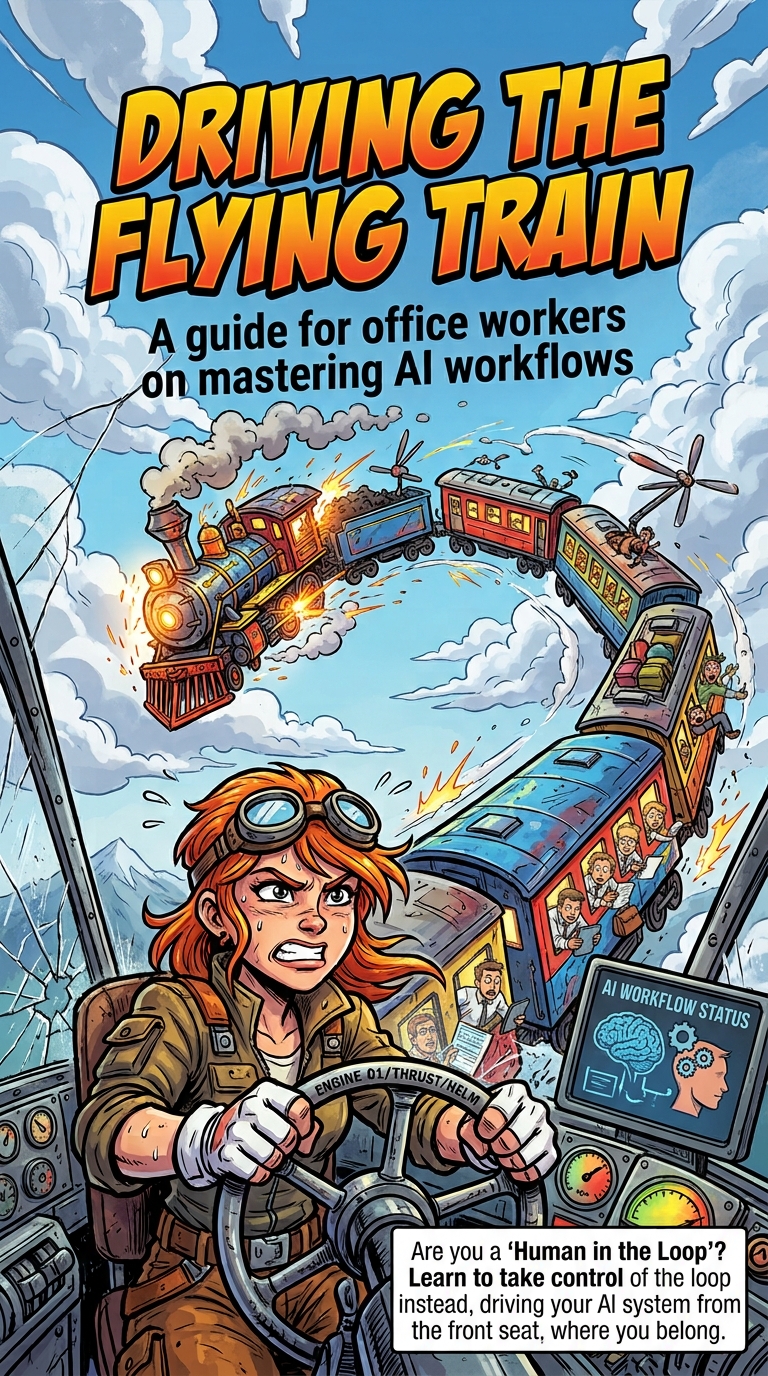
Driving the Flying Train
A guide for office workers on mastering AI workflows
Are you a “Human in the Loop”? Learn to take control of the loop instead, driving your AI system from the front seat, where you belong.
Alex Finkel · with Brinley Hosking
We need to move from “human in the loop” to “human drives the loop.” The difference matters: one makes you an approver, the other keeps you in charge.
This is a collection of ideas, models and practical techniques for getting more out of AI — built from real experience, not theory. It’s written for people in offices and teams, not software engineers. Each chapter stands alone; read what’s useful, skip what isn’t.
Chapters
1. Escaping the Bad Zone · Drafted
Before you can drive the loop, you need to know what the machine does well and where it falls apart.
2. The Good Zone · Planned
Learn to use the Three-Chat Model to rapidly research best practices for any AI task and execute them with high fidelity.
3. Trading off Time for Fidelity · Draft
A 2-minute prompt gets you a 2-minute answer. Spending 20 minutes on process gets you something you can trust.
4. Handling Big Tasks · Planned
AI forgets. Understanding why — and working with it instead of against it — is the key to tackling anything longer than a page.
5. Advanced Workflow Management · Planned
When you stop typing prompts and start designing systems.
6. Evals · Planned
You can’t improve what you can’t measure. Evals turn “I think this works” into “I know this works.”
7. Learning Process · Planned
The AI gets better at your work over time — if you build the feedback loop.
8. Learning Knowledge · Planned
Teaching the AI what you know, and letting it find what you don’t.